
Alabama Property Tax Records by Field
Alabama splits assessment from collection. The county assessor or revenue commissioner keeps the real-property assessment record, while the local tax collector or the revenue commissioner's collection division handles bills, payments, receipts, and delinquency. One property tax record can therefore span two county systems. Match the parcel identifier and tax year first.
| Field | What It Shows | Where |
|---|---|---|
| Appraised or market value | Value used as the base before the classification ratio | County assessor or revenue commissioner |
| Assessed value | Appraised value after the Alabama property-class percentage is applied | County assessment record |
| Exemption / home flag | Listed exemption or home-status field, when shown | County assessment record |
| Current-use field | Current-use value or indicator where the county portal has one | County assessment record |
| Tax district | District used to read the bill and local millage | Assessment card and local tax bill |
| Bill and payment status | Tax year, amount due, paid date, receipt, or delinquency details | County tax collector or revenue collection portal |
| Delinquent-tax transcript | Name, assessed value, bid, county/year, parcel ID, and description | ALDOR state-held tax-sale records |
An assessment is not a sale-price report. Alabama applies a property-class percentage to appraised value. The result is the assessed figure. The bill then layers on local tax districts and any applicable exemptions. Field labels vary by county. A tax card may show land, building, current-use, or home fields. Those names differ from one office to the next. The Alabama Department of Revenue assessment page sets out the statewide formula.
ALDOR's official assessment-class table shows the percentages behind the assessed-value calculation. For that distinction, see the separate Alabama property value explanation.
That percentage marks an assessment class. It is not the tax bill, nor an independent market appraisal of the property.
Alabama Assessor Search Fields
County assessment portals use local field names rather than one statewide form. Walker County's GIS/CAMA search is one example. It accepts a parcel pin, account, owner, physical address, acreage or value range, district, and subdivision. It accepts a parcel pin, account, owner, physical address, acreage or value range, district, and subdivision. Walker's instructions say to omit beginning zeroes from the parcel pin. A partial-name search works too. Butler's expanded assessment search goes further. It adds mailing address, exemptions, deed type and date, plat book and page, and section, township, and range.
Treat this field list as a map, not a promise. Not every Alabama county offers each control. Walker's result tabs separate Basic, Parcel, Building, and Land information. Its acreage and value fields work as ranges. Which tax districts and subdivisions appear depends on the data each county has configured in its system.
| Field label | Type | Required | Options or format notes |
|---|---|---|---|
| Parcel Pin | Text | No | Walker instructs users to enter it without beginning zeroes. |
| Account | Text | No | County account number. |
| Parcel(s) | Structured text | No | County-specific prefix and segments; Walker shows a 64- pattern. |
| Owner | Text with direction/select control | No | Partial last-name search works; Walker gives “Jones W” as an example. |
| PhyAddr | Split text | No | House number and street name for a physical-address search. |
| TL Acres | Two numeric range fields | No | Greater-than/equal and less-than/equal values. |
| TL Value | Two numeric range fields | No | Greater-than/equal and less-than/equal values. |
| District | Dropdown | No | County tax districts; available options vary. |
| Subdivsn | Dropdown | No | County subdivision list where configured. |
| Search | Button | No | Runs the selected criteria. |
| Basic / Parcel / Bldg / Land | View tabs | No | Switches between result groups and detail. |
| MailAddr / Exemptns | Butler expanded-search fields; control type not stated | Not stated | Searches a mailing address or exemption field. |
| Deed Type / Deed Date | Type and start/end fields; control details not stated | Not stated | Filters by a deed category or date range. |
| Plat B/P | Butler expanded-search field; type not stated | Not stated | Uses the plat book and page reference. |
| Section / Township / Range | Butler expanded-search fields; type not stated | Not stated | Supports a land-description search. |
| Basic / Parcel / Land / Bldg / Imp | View tabs | Not stated | Butler's expanded portal separates result details into tabs. |
Walker's sample result shows what a search can return once a parcel is selected. Its record inventory includes:
- Account, PPin, and parcel number, with county-specific parcel formatting.
- Owner's Name and Parcel Address, plus a separate mailing field where the county displays it.
- S-T-R, tax district, total-land acres, and subdivision.
- Method, location, and unit details for land segments.
- Land Value, current-use value, Is CU, and Is Home indicators.
- A map action that can zoom to the selected parcel.
Walker County's assessment search and its sample land result show why the parcel card matters for property tax review: it joins identity fields, land-value fields, and map references in one place. Counties label and group those values differently.
ALDOR's county assessor and appraisal directory links to local offices and their search systems. Use it to reach the land's county. Then confirm what you opened. The page may be an assessment card, a tax bill, or a map view.
Find an Alabama Property Tax Bill
Alabama has no single statewide bill portal. Payment status and any parcel or account lookup come from the local collector or the revenue commissioner's collection division. Start with the county assessor directory when the local system is unfamiliar. Keep two records separate. The assessment describes value. The bill shows the amount billed and its payment status for a tax year.
- Resolve the county that holds the parcel, then use its assessor or collector link. A postal city name or ZIP alone may not identify the county.
- Search the physical address or the parcel, account, or pin number accepted by that local portal. Record the tax year shown on the result.
- Read the appraised or market value, assessed value, class, listed exemption, and tax district on the assessment card. Keep the fields and their labels as displayed.
- Open the collector's bill view for the same parcel and year. Note the amount due, payment status, paid date, receipt, and any delinquent amount or added charge the page displays.
- If the account is delinquent or linked to a sale notice, check the county record and the ALDOR transcript separately. An amount in a state transcript may not include a street address.
- Appraised value
- The assessor's value base before the property-class percentage is applied.
- Assessed value
- Appraised value multiplied by the class percentage under Alabama's formula.
- Millage or levy
- The local tax-rate component applied through the bill's taxing districts.
- Homestead exemption
- A property-tax exemption category tied to a qualifying homestead; Alabama lists H-1 through H-4.
- Tax lien
- A tax claim attached to the property under the tax process; check the county and ALDOR record for its current status.
A missing bill has two fixes. Call the county collection office at its published number, or send a narrow written request listing the parcel, the tax year, and any known bill or account number. Ask which form, delivery choice, and copy charge apply.
Alabama's Assessed-Value Formula
Alabama classifies property before taxing it. A classification percentage applies to appraised value to produce the assessed value. Class III covers agricultural, forest, and single-family owner-occupied residential property at ten percent. Class II property sits at twenty percent. Class I utility property is taxed at thirty. The class drives the assessed-value calculation, while local millage and exemptions shape the final bill. Never call the assessed amount a sale price or a current market appraisal.
The local roll holds the exact classification and value fields. A parcel card may list land and building amounts, a current-use value, an “Is CU” flag, a home flag, and exemptions. It may also show a tax district. Labels in one county are not a statewide standard. Check the assessment date and class. Do this before using any number in a tax or appeal question.
A current-use field hints at special treatment. It does not explain rollback conditions or later tax effects. Confirm the treatment with the county office before relying on the amount.
Alabama Homestead Exemption Classes
ALDOR groups homestead relief into four classes, H-1 through H-4. Eligibility turns on age, disability or blindness, income, and how much land sits under the claim. A 160-acre cap appears in the published rules. The limits shift by class. An owner should read the current state table and ask the county revenue office about applying. The official homestead exemption page carries the rules and the local application path.
An exemption label or home flag on the assessment card is only a hint. It shows how the roll treats the parcel. It does not prove residency or replace the application record. A listed exemption may be missing. Or it may clash with the parcel. In either case, ask the county assessor or revenue commissioner whether the filing was processed for that tax year.
Confirm the class and any exemption first. Only then compare taxable assessments. Two homes with near-identical appraised values can land on very different taxable amounts. Classification and exemption status drive the math on the tax roll.
Alabama's October-to-May Tax Cycle
ALDOR keeps a statewide calendar for property taxes. October 1 marks the due date and the lien date. An account turns delinquent after December 31. Delinquent accounts move to probate in February. The court meets in March, and notice runs in April. The tax sale is commonly held in May, usually on the first Monday. For a specific bill or payment, ask the local collector. The current ALDOR page controls the parcel's status and the next step.
ALDOR's official property-tax timetable lays out each stage of the cycle. The image shows the state calendar. A county tax account remains the source for a specific bill or payment.
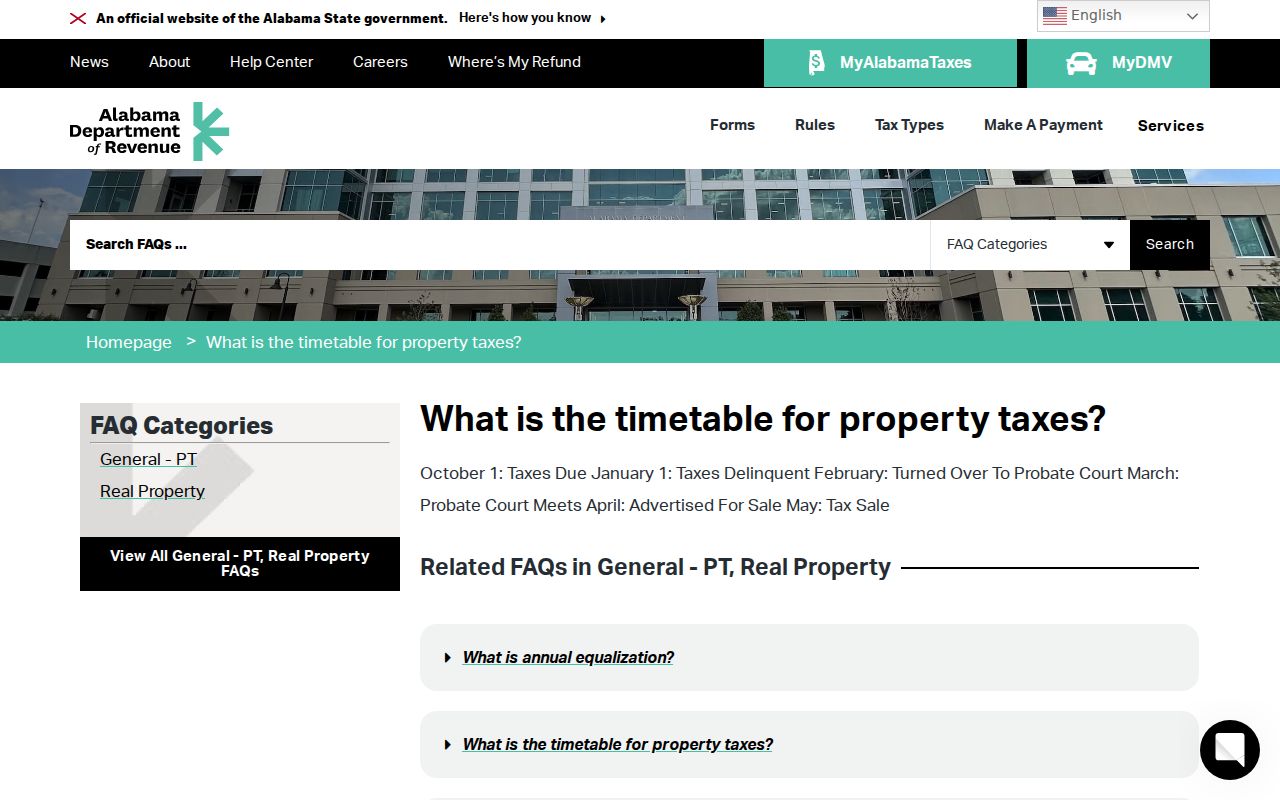
The calendar describes a statewide sequence, not a promise that a particular parcel will be sold. Before acting on a delinquency entry, pull the county account and read the underlying notice recorded against the property.
Alabama Tax-Sale Transcript Fields
The ALDOR tax-delinquent property page posts county transcript PDFs for state-held land. It refreshes them weekly. A transcript may not carry a physical address at all. Instead, it can identify the property by a long parcel ID. It may also add a legal description built on section, township, range, block, lot, or metes-and-bounds language. Match the description against county map records and plat data. Do this before drawing any conclusion about the land. Fields in the transcript include:
| Field | What it identifies |
|---|---|
| Name and county | Name shown for the account and the Alabama county. |
| AV and Amount Bid at Tax Sale | Assessed-value label and bid amount reported in the transcript. |
| Year, C/S number, Class, Code | Tax-sale year and state transcript classification or reference fields. |
| Parcel ID and Description | Long parcel identifier and legal description, which may be needed when no street address appears. |
Under ALDOR's rules, a state-held certificate under three years may be assigned. A tax deed may issue after three years. Redemption can remain open within that same three-year window. Interest, taxes, fees, and penalties accrue. The rate is 12 percent per year. Before deciding anything, confirm the certificate, redemption, and parcel status against the official record.
A tax sale is not a clear-title finding. Paying another owner's taxes does not itself make the payer the property owner. ALDOR advises a title review before a delinquent-property purchase, and a certificate or tax deed must be read with the court, redemption, and land records.
Alabama Tax Roll and Deed Dates
The October 1 lien date explains a common mismatch. A deed and an assessment card sometimes show different owners of record. A deed may be recorded after the assessment snapshot. The tax roll then still reflects the last conveyance the county processed. Alabama publishes no statewide refresh date or post-closing lag. Ask the county directly. Ask whether a deed, exemption, address correction, or parcel split has been processed yet.
When the tax roll and a recent deed disagree, compare the parcel number first. Compare the legal description too. A split parcel or an old parcel number can send a property search to a different account. The assessment shows how the county placed land on its roll. The probate index and recorded deed show which transfer was actually filed. Neither field should quietly stand in for the other.
An official Alabama records request should name the county office and the parcel. It should also name the tax year and the exact record sought. The Alabama Open Records Law lets the custodian use a standard form and estimate a reasonable fee. It also lets the custodian route a time-intensive request through a separate process. County procedures and access limits still apply to deed records and tax rolls alike.
Alabama Property Tax Bill Fields
County tax-bill portals do not share one statewide layout. A local account page is sometimes available. Note the parcel or account number first. Note the tax year too. Then record the bill number, owner, and property address. Add the amount due, the delinquent amount, and any listed penalties or interest. Finish with the paid date, receipt number, and payment status. A portal may show only some of these fields. It may also send the search to a separate payment vendor.
Compare like with like. Use the same parcel and the same tax year. Then set the assessment card next to the collector bill. Keep appraised value, assessed value, exemption, and district separate from the bill balance. A record may show the assessed figure without the full amount due. A payment page may show the bill but not the calculation behind it.
Some counties use an account number rather than an address. In that case, keep both the parcel identifier and the physical location in your notes. The tax notice's mailing address can differ from the parcel's situs address. A blank address is possible for rural or vacant land.
Get an Alabama Tax Record Offline
ALDOR keeps a directory that covers all 67 counties. It links each assessor and revenue office, local search systems, phone numbers, and mailing addresses. When a bill is not online, call the county number or ask at the counter. Staff can often provide a prior-year bill, a payment receipt, or an assessment card. Some offices rely on a request form instead. Mail, email, or fax options may be listed for copy requests. Check local terms before you send payment or personal details.
A written request works best when it is narrow. Name the county office, the parcel or account number, and the tax year. State the document you need, and whether you want an electronic or paper copy. Alabama's Open Records Law, Ala. Code §§36-12-40 through 36-12-46, as amended by Act 2024-278, allows an office to set its own procedures. It may also estimate reasonable fees before a search. The standard timeline is acknowledgment within ten business days. Then a substantive answer comes within fifteen business days after that, subject to extensions. Time-intensive requests follow a separate track.
Remember that public status has limits. A general request cannot open personal tax information or other records closed by law. If the county asks for a narrower description or a fee estimate, identify the parcel and year. Do not request every tax record tied to a person.
Protest an Alabama Property Valuation
Disagree with the value placed on your parcel? ALDOR allows a written protest to the county Board of Equalization (BOE) within 30 days after you receive written notice of the valuation. Read the notice closely. Then contact the county assessing office or the BOE for current local filing instructions. Gather the parcel number, the assessment year, the valuation notice, and any records supporting the value you believe is correct before you draft the protest. ALDOR's property valuation appeal guidance states the window and the statutory references.
Valuation protest window. A written protest to the county BOE is due within 30 days after receiving written notice of valuation. Follow the notice and county instructions for filing details.
Exemption applications and parcel-field corrections follow a different path. Contact the county office and ask whether the assessment record reflects a processed application, correction, or parcel split.