
Alabama's Current Owner Record
The Alabama tax roll is the practical place to find the current owner of record for a parcel. That term means the party named in the assessment record. County systems label the field "Owner" or "Owner's Name" depending on the software. A typical Alabama GIS/CAMA card pairs the owner name with parcel and account identifiers, a physical address, tax district, acreage, and land values. Portal layouts differ from county to county. Read the field labels and the roll year before trusting any result as current.
| Field | What the Roll Shows |
|---|---|
| Owner / Owner's Name | Name attached to the assessment account; it may be a person, estate, trust, or entity. |
| Parcel Number / Account | County identifier used to match the parcel across local assessment and map systems. |
| Parcel Address / Situs | Physical location of the tax parcel, if an address is assigned. |
| Mail Address | Where tax notices are sent; some systems use a separate field. |
| Deed Type, Date, or Sale History | May appear in a county portal; verify a reference in the probate land index. |
| Land / Current-Use Values | Assessment details, including a separate value treatment for qualifying land, not deed ownership terms. |
A Walker County sample result shows an owner's name, parcel number, parcel address, section-township-range, district, acres, land and current-use values, a home flag, and subdivision. Some Alabama portals add building, exemption, sales, or mailing detail. Keep the limits in mind. The roll is an assessment record. So it may not show every term of vesting or every interest in a deed.
Why an Alabama Owner Roll Can Lag
Alabama property tax records run on an October 1 lien date and an annual cycle. Assessor update timing, though, is set locally. A deed can sit recorded in the county probate office for a while before the new owner surfaces on the next roll or a county's local update. No single statewide number covers that delay. After a recent closing, compare the dates rather than assuming the tax card rolled forward. The assessor can confirm whether a deed, address correction, parcel change, or exemption application has been processed. Until the roll catches up, a recently recorded deed is the more current owner record.
Check the recording date. If the assessor still shows the prior owner after a sale, find the newest county probate deed and match its legal description to the parcel.
Confirming the Current Alabama Owner
Start with two things side by side. One is the assessor's present tax roll. The other is the newest deed recorded for that parcel. The roll shows the current name. The deed shows the grantee plus its recording date. Before trusting the match, compare the parcel number and the full legal description. A shared name or a near-identical street number can quietly steer you onto the wrong property.
- Copy the county's exact owner field, parcel number, situs address, and any deed reference shown.
- Search the county probate land index for the latest deed under the owner or parcel description.
- Compare the grantee, recording date, and legal description with the assessor result.
- If an entity is named, verify its exact name in Alabama's business-entity record.
- Owner of record
- The party named in the current assessor roll or recorded conveyance.
- Assessment roll
- The county's taxable-property record, updated on a local cycle.
- Situs address
- The physical parcel location, separate from its tax-mail address.
- APN
- The assessor or mapping identifier used to match the parcel across local systems.
- Grantee
- The party receiving an interest under the recorded instrument.
- Legal description
- The deed or plat wording that identifies the land beyond a street address.
This kind of check answers one narrow question. It confirms the present roll name and the recorded deed behind it. It does not reconstruct a complete chain of title. And it says nothing about who actually occupies or uses the land. A full title review for a specific transaction calls for the recorded instruments. It also draws on every related record tied to that property.
Alabama Owner Mailing and Situs
A tax card carries two different addresses. The mailing address is where the assessor sends notices. The situs is where the land actually sits. Those two can be miles apart. The mailing line might belong to an owner, an attorney, a lender, an estate representative, or a company office. A vacant parcel may show a blank situs or an outdated street number.
Read each field exactly as printed. An out-of-county mailing address proves nothing about who lives in the home. A city name inside the situs address does not tell you which office holds the parcel record. If an address looks changed, fall back on the parcel identifier and the legal description. Do not assume a new mailing address means a new owner.
Use APN to Check Alabama Owner
A parcel number, or APN, is the more reliable key. Two owners can share a name, or the roll may list an estate or company. Alabama display formats differ from county to county. A sample Walker County card prints the parcel number, the account, and the section-township-range. Other CAMA systems label theirs a PIN or PPin. Copy the value exactly, keeping any leading zeroes, spaces, or separators intact.
Older deeds sometimes predate today's APN. A split or consolidation can hand a lot a brand-new number too. The assessor or mapping office can tell you which current parcel replaced an outdated identifier. Always match the legal description. Accept the tax-roll name as the owner only after that match confirms it is that exact lot.
Alabama LLC, Trust, Estate Owners
An owner line can read like a puzzle. It may name an LLC, a corporation, a trustee, a trust, an estate, or a personal representative rather than a person. Match the exact spelling from the deed and tax roll, then run the name through the Alabama Secretary of State's business entity records, which search by entity name or number and can surface officers, agents, and incorporators.
Read the results with care. A registered agent receives legal papers for the entity but is not necessarily the owner of record or the occupant of the parcel. Trusts appear under the trust name or the trustee. Estates are trickier still. The index may list the decedent, the estate itself, the personal representative, or an heir, and the probate court file stays separate from the recorded land instrument.
Alabama Current Deed Date
A parcel card's deed type, date, or instrument number is a pointer, not proof. The probate land index supplies the filing date and the parties. The recorded image carries the instrument text and legal description. A portal's "certified through" banner only describes index coverage. It says nothing about when the current owner took title.
Coverage varies by county. Baldwin County reports a deed and mortgage index from 1899 to present. Mobile County lists land records from 1813 to present. Its images run from September 1995 forward. Those dates apply to those counties alone. A free index can sit beside separate local charges. Those charges may cover images or certified copies.
The Baldwin Official Records Search and Mobile Probate Records search show two different county approaches. To trace an address to its owner of record, see Alabama ownership record steps. For ordering and reading an instrument, use the deed-record reference.
Alabama Owner Alerts and 2026 Law
An owner alert is a free, optional service in some Alabama counties. Register a name. The county then sends an email notice whenever that name shows up in a land-record filing. Baldwin County frames its alert as a fraud-prevention tool. An alert is only a notice, though. It does not block a recording or guarantee title. Still check the actual county record whenever one arrives.
Deed fraud is also drawing a legislative response. The Alabama Property Protection Act of 2026 takes effect October 1, 2026. It targets seller-impersonation schemes. The Alabama Securities Commission is still drafting its process, rules, and forms. Because alert services stay local, the probate office's current instructions govern each signup. The Baldwin County property-alert page offers one example of a local enrollment route.
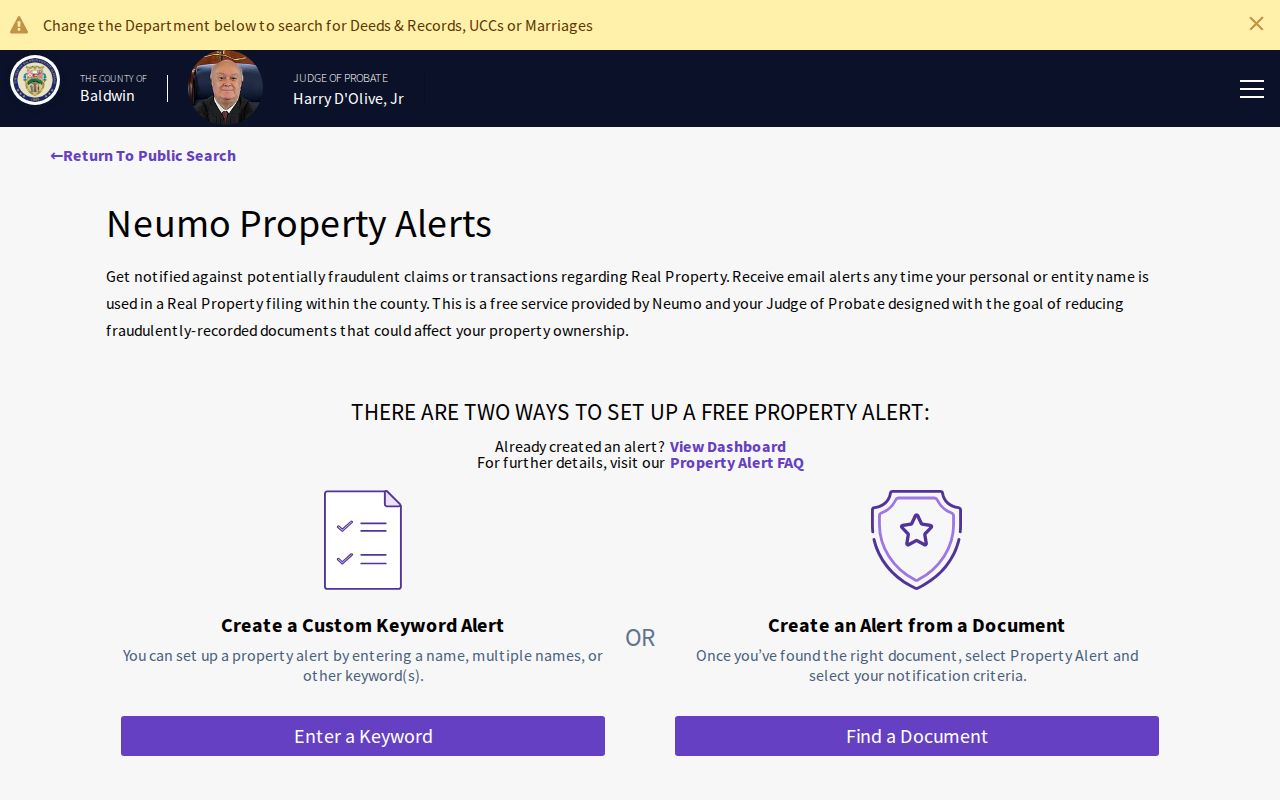
The example above is a Baldwin County service. It does not mean a statewide alert covers every Alabama parcel. For act details statewide, check the Alabama Securities Commission Property Protection Act page.
Alabama Current Owner Record Access
Start online with the county assessor or revenue commissioner linked by ALDOR's county directory. If the roll lacks a field or appears behind, call the local office or visit its public counter and ask about terminals, parcel history, recent deed processing, and copy rules. A probate recording office can confirm the index date and provide an instrument image or certified copy; its fees and mail process are set locally.
A written request under Alabama's Open Records Law can seek a specific public record. Identify the county and office, parcel/APN, names, likely instrument or record type, date range, and electronic or paper format. Standard requests are generally acknowledged within 10 business days and receive a substantive response within 15 business days after acknowledgment, subject to extensions and time-intensive-request procedures. The custodian may estimate reasonable fees before searching.
Some identifying information may be redacted under law. Mobile Probate Court's identity-theft resources describe a limited request process for people in qualifying positions under Ala. Code §§41-13-7 and 41-13-7.1; that is not a general statewide deletion right for owner fields.