
Alabama Deed Records by Instrument Type
County probate recording divisions across Alabama preserve important instruments. These filings give public notice of a land transfer or claim. A deed conveys whatever interest its text describes. The label on the instrument helps sort the index. But the legal description and related filings explain the actual transaction. Alabama land indexes can cover ordinary conveyances, estate transfers, tax sales, and corrections. Category names depend on each county's system.
| Deed Type | What It Does | Common Use |
|---|---|---|
| Warranty deed | Conveyance recorded under this deed type | Trace the named grantor and grantee |
| Statutory or limited warranty deed | A separately indexed warranty form | Read the filed instrument for its terms |
| Quitclaim deed | Conveys the interest stated by the grantor | Compare the legal description and prior reference |
| Executor or administrator deed | Estate-related conveyance | Pair the land filing with the probate record |
| Deed of distribution | Estate distribution instrument in the land record | Check related estate filings |
| Tax or sheriff's deed | Deed type tied to a tax or sheriff sale | Review the sale, court, and redemption record |
| Correction deed | Later deed filed to correct a prior instrument | Compare both recordings and descriptions |
A deed is only one piece of a larger property records set. Mortgages, liens, easements, plats, releases, and assignments may share the same probate index. Yet not every instrument transfers ownership. Read the type field, party roles, recording date, and legal description together. A deed index can point to a useful filing. It will not tell you whether later claims were released.
Alabama Baldwin Index Fields
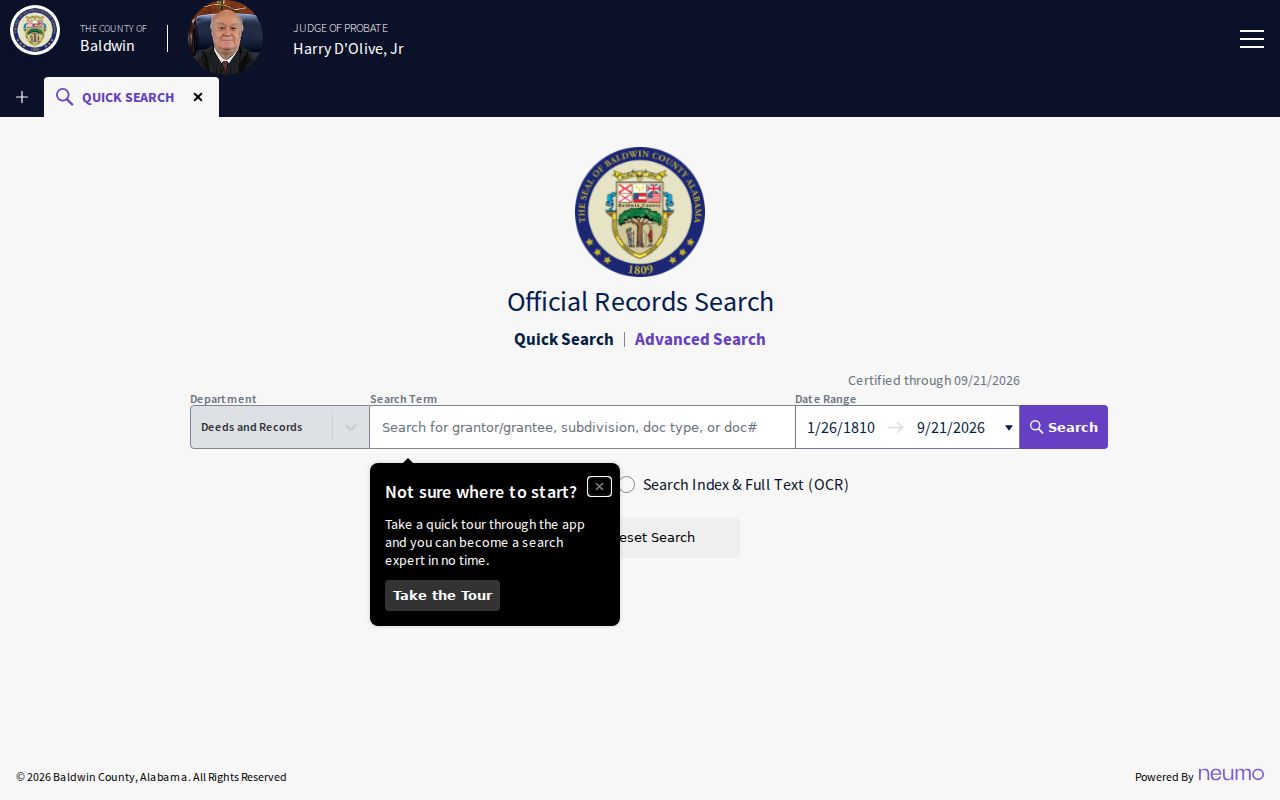
Baldwin County offers a concrete example of an Alabama deed index with several search paths. Its Official Records Search covers deeds and records. It accepts a term for a grantor, grantee, subdivision, document type, or document number. The county's recording page states that deed and mortgage indexing begins in 1899 with Book 1. It runs to the present. That date reflects Baldwin's coverage alone, not a statewide start.
The portal's search controls reveal what the index exposes before an image is opened. A certified-through date appears on the site. It serves as a current-through signal rather than a historical cutoff. Image and view charges are set locally, not by one Alabama rate.
Baldwin's official records portal displays the deed and index search surface. It shows a single county system. So use the local county page for its own search choices and image terms.
When a result stays unclear, try the party's name in the other role. You can also search by the document reference listed in a related instrument.
| Field or control | Type | What it permits |
|---|---|---|
| Record category | Displayed category | Shows Deeds and Records on the inspected quick-search surface. |
| Search Term | Text | Searches grantor, grantee, subdivision, document type, or document number. |
| Date Range | Start and end dates | Pair both ends to narrow a recording period. |
| Recorded Date | Quick-range selector | Offers recent ranges from the last day through one year. |
| Search scope | Radio or select control | Chooses index only or index plus full-text OCR. |
| Search and Reset Search | Buttons | Runs or clears the criteria. |
| Advanced Search | Tab or link | Opens a separate advanced-search mode. |
| Register, Sign In, Cart | Account controls | Used for image or cart services, not needed for the visible quick search. |
Baldwin says users can view and print documents through its site. Its posted recording fee is $13 for the first page and $3 for each additional page, plus a local data-processing fee. Those are recording charges, not a statewide copy-image schedule. Ask Baldwin for current image costs and certified-copy steps before ordering.
Mobile, Alabama's Book-Page Search
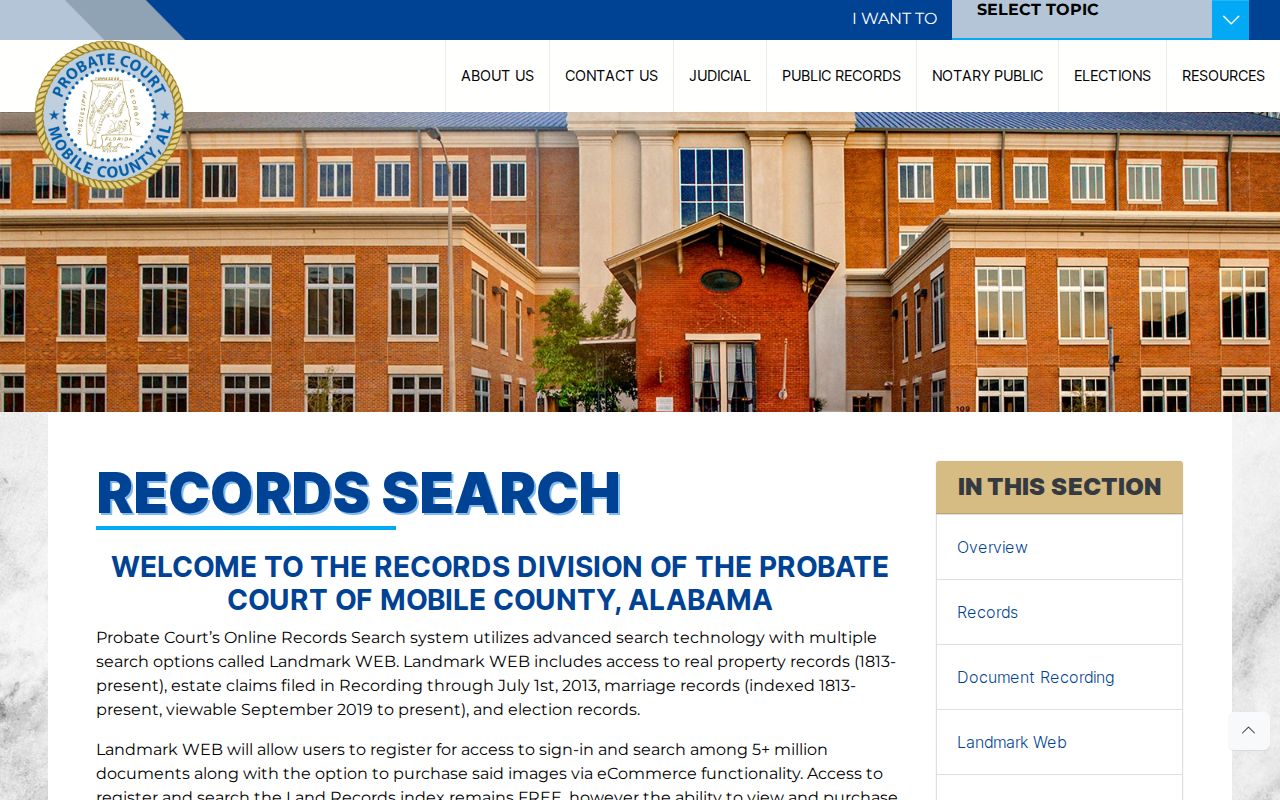
Mobile County shows a different Alabama deed-record path. The Probate Records Division offers a free index search. Document images cost $0.10 per page. They can be downloaded or printed for ten days after purchase. A monthly subscription is listed at $125 for high-volume access. These are Mobile's terms alone.
Mobile's official records list separates the county's land-record eras. Deed books run from 1813 through 1958. Map books run from 1872 to present. Mortgage books run from 1851 through 1958, and real-property books run from 1958 to present. The listed real-property indexes begin in 1984. The document image set starts in September 1995. The sheriff's deed book list covers 1942 and 1955 through 1958. An index entry can predate the online image for that filing.
The Mobile County Probate Records Division page describes the free index and current image charges. Its records list helps distinguish years covered by books, indexes, and online images.
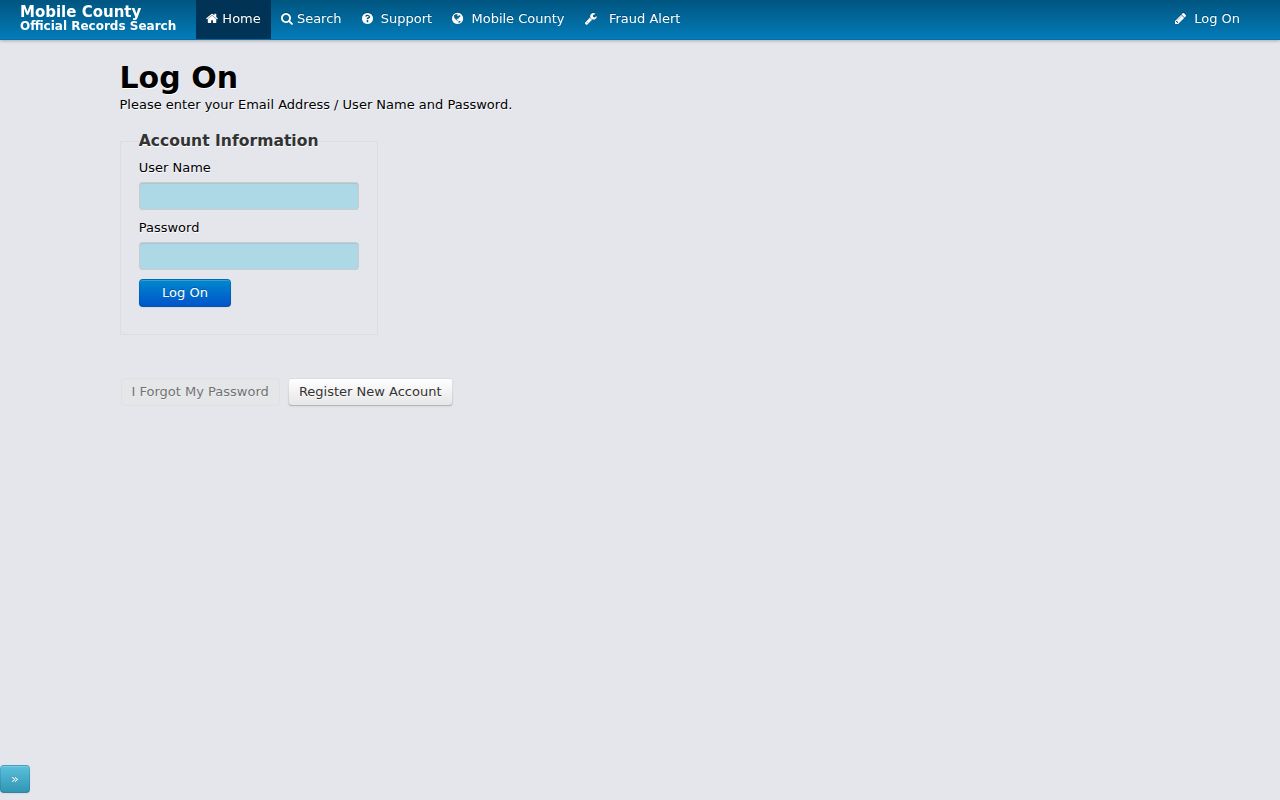
Use the Mobile Landmark Web search for the county's online index. Its guide says Book and Page are required in that mode. Entering Page 1 returns all pages in a book, and Book Type narrows the results. Results support column filters and a first-1,000-records control. The guide also suggests trying spelling variations.
The same Mobile Landmark Web search is the current online entry point. It serves an Alabama deed search in that county. A visible search screen does not mean every older book has an image online. Mobile reports electronic recordation began in 2014. Its online image set starts in September 1995. The dates describe different stages. An image library can include scans of older paper filings made long before electronic submissions existed.
Note: Keep the index date and image date separate whenever a deed feeds into a longer ownership review.
Alabama Grantor and Grantee Index Steps
Alabama probate land indexes are usually organized around the parties. The grantor conveys the interest. The grantee receives it. A search may return both names. It may also return a document type, a date, and a book or instrument reference. County systems differ. Some offer parcel-number search while others rely on names and legal descriptions. Search both sides of a known transfer, because the buyer and seller appear in different roles.
- Search the likely party name, document type, or known recording reference. Add a narrow date range when the portal supports it.
- Read the result's party roles, date, document type, and legal description. Note the exact recording reference before leaving the result.
- Open the image where available and compare the names and land description with the result. Search related instrument references for a correction, release, or earlier deed.
- If the index has no image or no entry, ask the county about its book, index, and microfilm holdings for the period.
- Grantor
- The party named as transferring the interest in the instrument.
- Grantee
- The party named as receiving the interest.
- Chain of title
- The ordered record of transfers and related interests tied to one parcel.
- Book and page
- A location in a bound or digitized record volume.
- Instrument number
- A county's unique reference for a filed document; names vary by portal.
A single deed lookup has one aim: find the instrument and read it. Tracing the full chain of prior owners takes a different approach, since each recorded deed points back to the one before it. That route, and where coverage thins out, is covered in the Alabama former-owner record trail.
Alabama Deed Records Beyond Conveyances
Deeds are only the start of an Alabama land index. Probate recording divisions often index mortgages, assignments, modifications, assumptions, releases, satisfactions, and cancellations. Those filings sit right alongside the conveyances. Liens appear too. Mechanic's, judgment, state, and federal tax liens can all sit in the same property records. Easements, rights-of-way, covenants, condominium records, plats, and replats can as well. Probate instruments ordered into the land records show up there too.
Each filing type answers a different question about the parcel. A mortgage creates a recorded security interest. A later assignment can change which lender the deed records name. A release or satisfaction is its own separate filing to locate. A plat shows the subdivision layout. The deed's legal description identifies the exact land conveyed. Whenever the portal supports parcel or legal-description fields, search on those too. Party-name results alone may not reveal whether a filing touches the parcel in question.
Some situations demand more than the index. A foreclosure, a mechanic's lien dispute, or a court-ordered transfer may require reading the county land index. It may need to sit beside the matching circuit or probate court file. Remember that a case entry and a recorded deed remain separate records. The land record is the authority on what instrument was filed against the property.
Fields in an Alabama Deed Index Result
Think of an index result as a locator rather than the deed itself. Alabama portal records typically show the indexed party, the other party, a document or reception number, and a recording date. A deed or lien category appears too. Book and page fields point to a specific volume. The legal description ties the filing to the land. Related-record references and an image link often appear on a separate result screen. The county opens that screen.
| Result field | What to check |
|---|---|
| Party name and role | Grantor or grantee; note which side of the transfer is shown. |
| Other or opposite party | The second party named in the instrument, where the portal displays it. |
| Instrument or reception number | The unique filing reference used to retrieve the record. |
| Document type | Deed, mortgage, release, lien, plat, easement, judgment, or a local category. |
| Recording date | The indexed recording date or the date range used to search. |
| Book and page | Historical volume location; Mobile requires these fields in its Book/Page mode. |
| Map book and page | Plat or map reference when the county result supplies it. |
| Legal description | Lot/block/subdivision or metes-and-bounds text tied to the land. |
| Prior or related reference | Earlier or connected instrument, when a link or number is exposed. |
| Image and redaction status | County-specific access route; personal identifiers may be omitted or redacted. |
Write down a precise citation from those fields. Then read the document image before trusting any summary. Indexing has limits. A party name can appear without a street address. Older land may be described only through a subdivision, lot, map reference, or metes-and-bounds text. If no image is available, the recording reference and legal description still give the county office a solid retrieval path for the deed records.
Alabama Deed Copy Routes and Fees
Check the county index first whenever it offers an online image. The result may be missing. The image may be blocked. A certified copy may be required. In those cases, turn to the probate recording office by counter, phone, mail, or its posted request form. The office may want the county, the parties, and an approximate recording year. It may also want the instrument type, book and page or instrument number, the parcel number, and the legal description. A narrow request gets routed faster than a demand for every record tied to a name.
Fees vary county by county. Mobile prices its images at $0.10 per page. The download and print window lasts ten days. It lists a monthly subscription for high-volume use. Baldwin charges $13 for the first page. It adds $3 per additional page as a recording fee. Its public page asks copy requests to include the recording information, book and page, and date. The county's portal must be checked for any separate viewing or copy price. Alabama sets no single statewide price for deed images or certified copies.
For an offline item, ask whether the office can supply a plain scan, a paper copy, or a certified copy. Ask also how payment is accepted. Alabama's Open Records Law, Ala. Code §§36-12-40 through 36-12-46, as amended by Act 2024-278, lets agencies set request procedures and estimate reasonable fees. Under the current standard-request process, acknowledgement is generally due within ten business days. A substantive response is due within fifteen business days after acknowledgement, subject to extensions. Time-intensive requests follow a separate process.
Older deeds may live only in a physical probate book, a county records room, or an archival copy. The Alabama Department of Archives and History county records database lists filmed county material by record type and date, though each county's runs differ. Call the local office before a trip and ask which series survives for the year you need.
Older Alabama Deed Records
Older Alabama deeds live in two places. The county probate office holds the local deed books. The state keeps an early land collection. The Secretary of State's Lands records search covers statehood through 1950. You can search it by name, township, range, section, or book. For later records, the Secretary of State points researchers back to the county probate judge's office. So a state search never replaces the local deed index for recent years.
When a deed book or index seems missing, start with ADAH's County Records on Microfilm catalog. Then check local holdings. Every county appears there. Coverage varies, though, in record types, dates, and how much was filmed. Some reels predate statehood. Many run into the 1950s. Most originals still sit with the county that created them. When asking an archivist for help, note the county and record type. Add the names, time span, and legal description.
ADAH's courthouse-fire map is another useful aid. A fire can damage some series. Other deeds and indexes can survive intact. Duplicates can bridge a lost volume. So can later re-recordings, microfilm, reconstructed indexes, tax rolls, and deed recitals. Pin down the exact county and record series first. Only then treat an apparent gap as a broken chain of title.
Building historians get specific advice too. The Alabama Historical Commission's guide to researching old buildings urges recording every grantor. It also asks for the deed-book reference. That citation carries a search from one deed back into an earlier book. It works without a modern street address. Old records never had one anyway.
Alabama County Recording Systems Change
Title 35, Chapter 4 of the Alabama Code contains the Uniform Real Property Electronic Recording Act. It lets county probate judges receive, index, store, archive, transmit, search, and retrieve electronic land documents. Older paper records can be converted too. But implementation is local. Each county picks its own timeline. So electronic recording dates and online image cutoffs vary across the state.
Local decisions shape what a property search returns. Shelby County issued a request for proposals in February 2025. It sought a cloud-hosted integrated land-information system for its probate recording department. That notice is a county-level transition. It is not a statewide migration. And it is not a new coverage date for any other county's deed records.
Before relying on an old search URL or a remembered portal cutoff, visit the current probate office page for the county that holds the deed. Ask whether an earlier index, image set, or paper book moved to a new system. An update may change fields and access. The historic book reference still points to the same recorded instrument.
The Shelby County recording-system notice is one dated example. For the county's current portal, records, and copy process, its own probate office remains the source.
Alabama Deed Alerts Are Notices
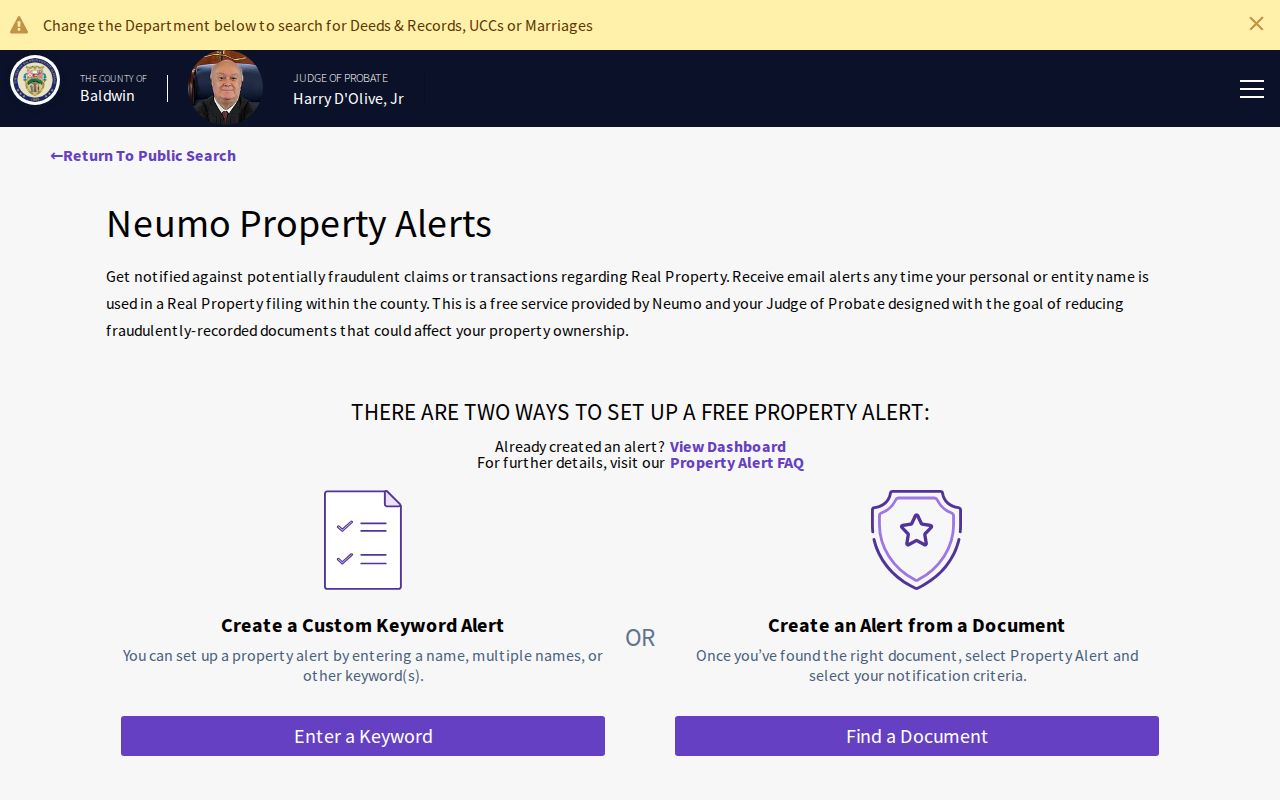
Some county systems let an owner register a name for an email alert when a land-record document is recorded. Baldwin County describes a free property-alert service, and Mobile County offers a similar notice tied to a registered name. These alerts can flag a filing for review; they do not block a document, insure title, or decide whether a filing is valid.
Baldwin's official property-alert registration page describes its email notification service. The image shows the alert sign-up route in one county system, not a statewide service.
Alabama's Property Protection Act of 2026 is scheduled to take effect October 1, 2026. The Alabama Securities Commission describes a framework aimed at seller-impersonation fraud. It also allows probate judges to set up owner-notification services. The Commission has been drafting implementation processes, rules, and forms. Its official Act page carries updates.
A deed record is evidence of a recorded instrument. It is not a ruling on its legal effect. A parcel map, assessor entry, court docket, and deed image each answer a different part. Together they make up the property records question.
Get an Alabama Deed Copy
Start with the county index for any single Alabama deed. Follow its image link if access is offered. The scan may not be online. In that case, contact the probate recording office by phone, at the counter, or in writing. Give the county, the parties, and the likely recording year. Include the instrument type and any book/page or instrument number. A parcel identifier and legal description help when the index lists no address.
Ask what the office can send. Options may include an uncertified image, a paper copy, or a certified copy. Each has its own fee schedule. Mobile lists a page price for images, while Baldwin's published page charge covers recording. Confirm any separate copy price before you order. Cite the index date and reference precisely. A tight request is far easier to fill than a broad one.
Recorded, not guaranteed. An Alabama deed index shows that an instrument was recorded; it is not a title opinion, and unrecorded interests or later filings may affect the property. Have a complete title review done for a purchase, inheritance, or dispute.