
Search Alabama Property Records
Start with the county. Then match the record to the clue in hand. A street address is often the easiest start. An assessor or CAMA search on that address can supply the parcel number and the owner name used on the tax roll. That number links the assessment card to the GIS map and, in some counties, to land-record indexes. To confirm a transfer, use the probate recording division's grantor-grantee index and retrieve the deed itself. The tax collector answers a different question: whether a bill is paid or delinquent.
Alabama property records are split across these offices. A tax card is a lead to the owner of record, not a title report. A GIS line is a tax-map reference only. Both take interpretation. When an online search stops at an index or a recent year, other routes remain. The county counter and written requests reach older books. The Alabama Department of Archives and History (ADAH) and the Secretary of State's historical land search cover earlier land records.
- Choose the county using the land's location, not only its postal city or ZIP Code.
- Search the county assessor or revenue commissioner's portal by physical address and save the parcel number and exact owner field.
- Use the parcel number, legal description, and owner name to search the probate deed index and confirm the latest recorded transfer.
- Check the county GIS viewer for parcel context, then use the tax collector's system for a bill or payment status.
- For a missing image or older volume, ask the local office about counter, mail, or records-request access, then check ADAH or SOS Lands.
Not every search starts with an address. The clue may be a book and page, a delinquent-tax transcript, or an estate file. Keep each office's role clear as the search moves from parcel discovery to recorded evidence.
Offices Behind Alabama Records
Alabama sets statewide rules. Each county holds the working property file. The probate judge records deeds, mortgages, liens, plats, and releases. The assessor or revenue commissioner maintains the real-property assessment, while the tax collector tracks payments and delinquency. GIS and mapping staff maintain the parcel geometry. Court cases affecting land sit with the circuit clerk or probate court, and the state publishes standards and statewide entry points rather than replacing local custodians.
Alabama Secretary of State Lands
Historical state land records through 1950
Post-1950 records move to county probate offices
SOS Lands Search
Alabama Revenue Property Tax
State assessment classes and tax guidance
County office links and local contacts
ALDOR County Directory
Alabama GIS Client Sites
County parcel viewers and mapping access
Free, subscription, and restricted systems
Browse GIS County Sites
ALDOR Links Each County Office
The ALDOR county directory is the statewide starting point. It works when the parcel's county is known but its local portal is not. Entries connect to revenue offices, appraisal and assessment searches, parcel viewers, GIS sites, phone numbers, and mailing addresses. Local titles vary. The assessor may be a tax assessor or revenue commissioner. It helps match the county's title and contact route. It is a directory, not a statewide parcel search. The owner, value, tax bill, and land index still live in separate county systems.
Settle the county first. A city on a mailing label can cross municipal lines. ZIP Codes cross county lines too. Then follow the assessor link for the tax roll. Probate and GIS links add deeds and map context. The ALDOR county-office directory also lists local phone and mailing information for follow-up.
The directory view below shows how the state page routes a searcher toward local offices, and the selected county's own portal sets the search fields and image options available.
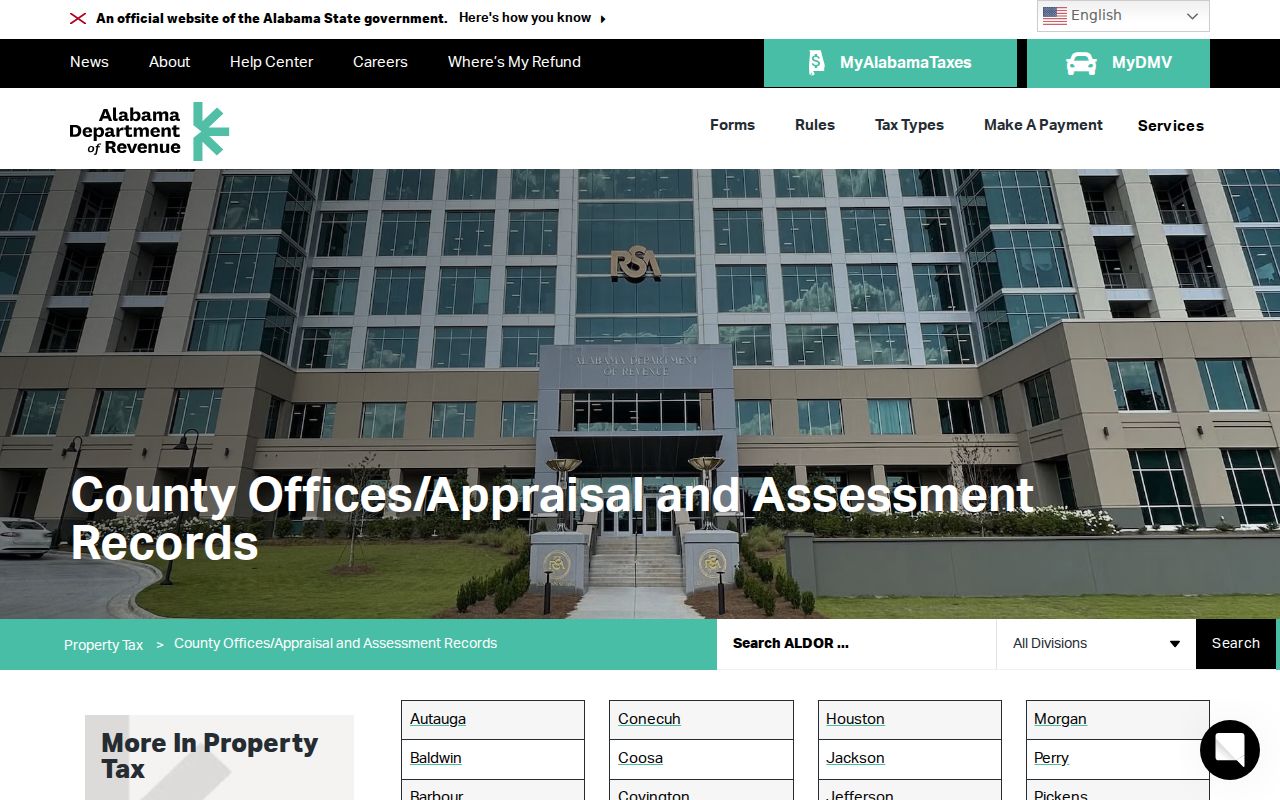
Open a county entry and check its links. Assessor, collector, probate, and GIS links may be separate. The directory is the handoff to the local record system, not the record itself.
County Deed Portals Have Different Reach
Alabama sets no single start date or image fee. Baldwin's official index says deed and mortgage records begin in 1899. Mobile describes real-property records from 1813 forward. Read the county's own coverage statement. Dates do not transfer between neighbors. In both places, an index result and a document image are separate access steps.
Baldwin's quick search accepts a term for grantor, grantee, subdivision, document type, or document number. Date ranges and recent recorded-date presets narrow it further. Searchers choose index-only or index-plus-full-text OCR, and the page displays the current certified-through date. Image and copy charges are not a single Alabama rate, so check the county portal or recording office before ordering.
| Search control | What it accepts | Use in the search |
|---|---|---|
| Search Term | Party, subdivision, document type, or number | Start with the name or reference already known |
| Date Range | Start and end dates | Limit a broad name result to a likely transfer period |
| Recorded Date | Recent quick ranges | Review filings from a recent period |
| Search Scope | Index only or index plus OCR text | Choose a wider text search when a name is absent from the index |
The Baldwin Official Records Search separates public searching from account, sign-in, cart, and image functions. A free index can identify an instrument. It does not make every image free.
The portal page shows party and document choices. Treat those controls as Baldwin-specific, since other counties use different fields or vendors.
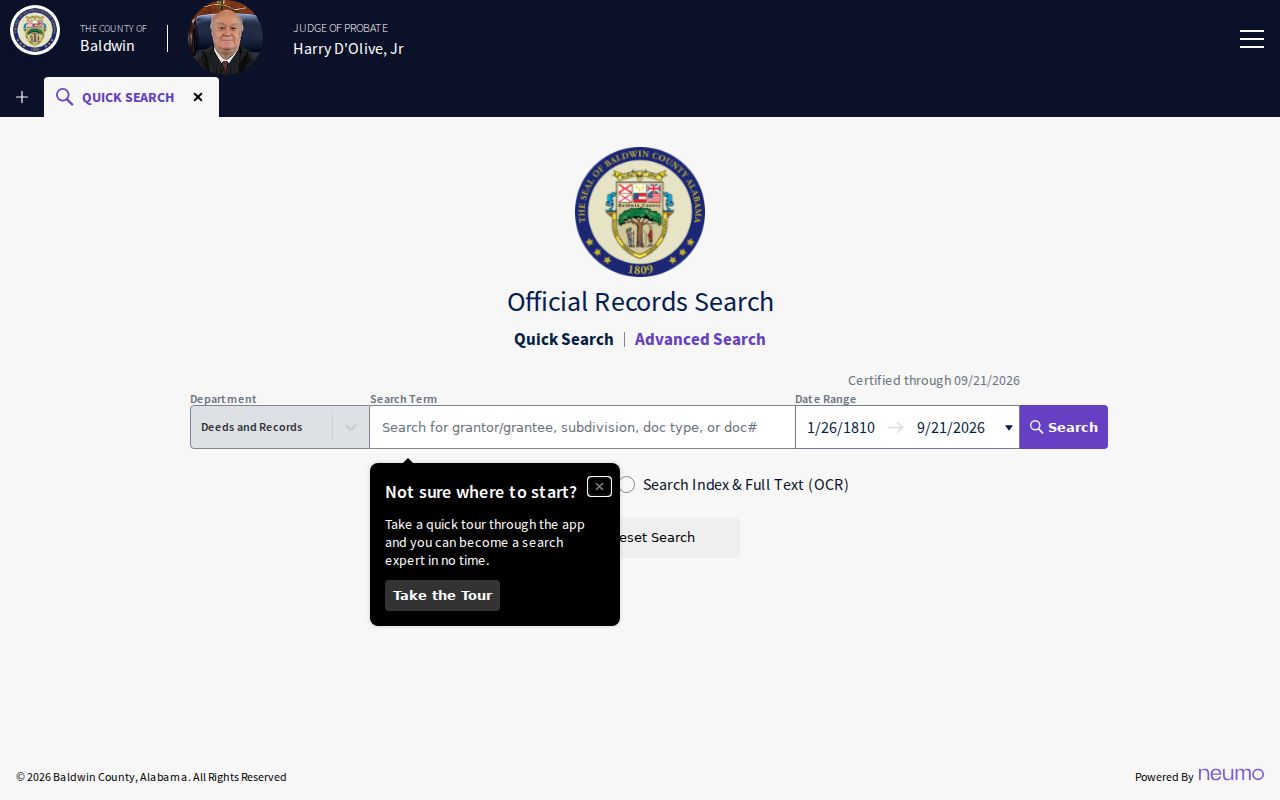
Every online index has an end. Request the book, page, or instrument number. Include the date or legal description, and ask the probate office whether the source is paper, microfilm, or a separate image system.
Mobile Shows the Older Record Layers
Mobile County lays out its land-record history with unusual precision. Deed books span 1813 through 1958. Map books reach back to 1872 and continue today. Mortgage books cover 1851 to 1958. Real-property books pick up in 1958, and real-property indexes begin in 1984. Document images start in September 1995. Those ranges apply only to Mobile's listed systems. They do not describe every county's record run in Alabama.
Access follows a simple split. The index search is free. Images cost $0.10 per page, and a monthly subscription covers high-volume use. Bought images can be downloaded or printed for a limited window. The county also lists public computer stations and in-person copy routes. Those help when an online image misses the book or page you need. The official Mobile Probate Records page explains the search service, while the records inventory describes each book series.
The page is a good model. It shows how a county can separate books, indexes, and image dates. Older instruments may still call for a courthouse, archive, or microfilm lookup.
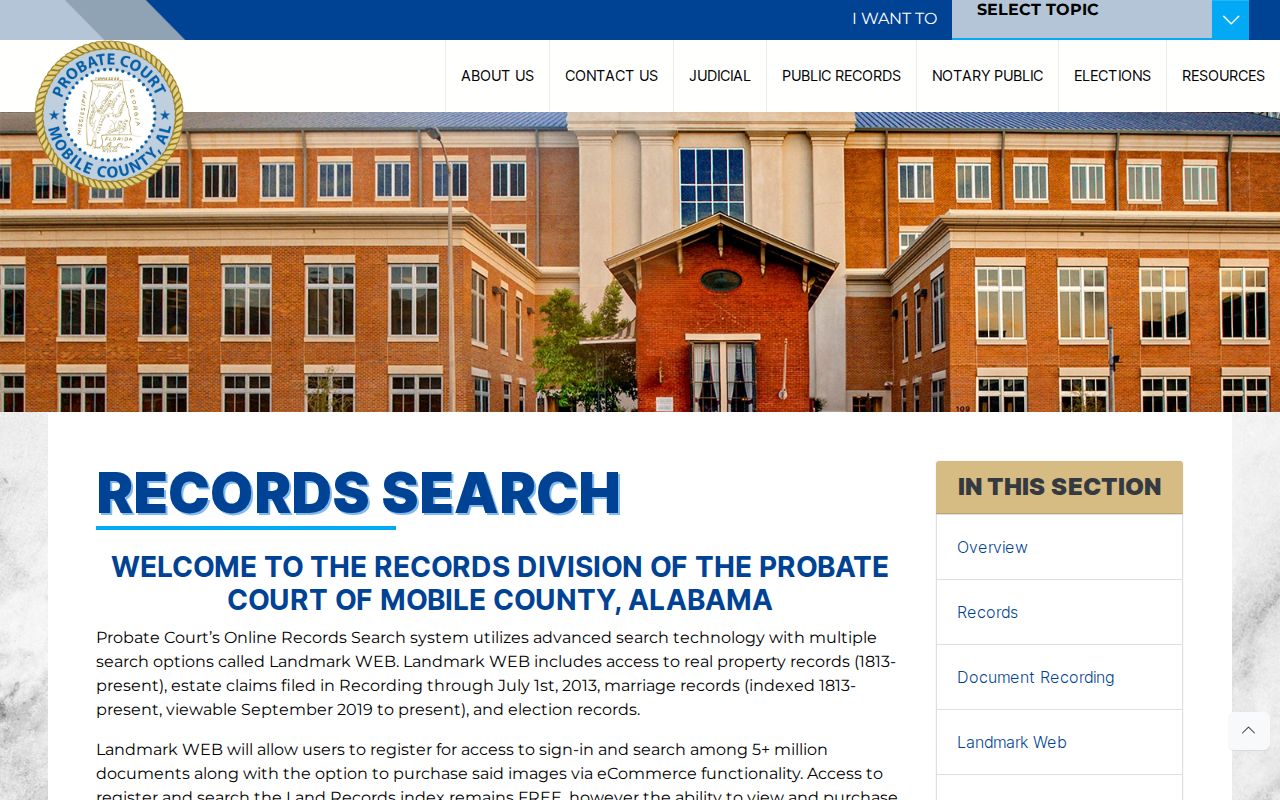
Let the date series guide your next access channel. A first online image year is not always the first index year, nor the oldest surviving deed book.
Alabama Property Records by Type
Different Alabama property records answer different questions. A deed records a transfer or similar land instrument. An assessment card shows the parcel as it stands on the current tax roll. A tax bill states an amount due and its payment status. A plat and GIS map add land and location context. Court and estate records can explain an order or transfer, though the matching deed or judgment may also need recording in the county land index.
| Record Type | What It Documents | Kept By | Access |
|---|---|---|---|
| Deeds and land instruments | Transfers, mortgages, liens, easements, releases, and plats | County probate recording division | Index, image, counter, or copy request vary locally |
| Assessment and tax roll | Owner field, parcel, values, classification, exemptions | County assessor or revenue commissioner | Local portal or office; fields vary |
| Tax bill and delinquency | Tax year, amount due, paid status, delinquency | County tax collector / revenue office | County payment or bill lookup |
| GIS and tax maps | Parcel ID, map geometry, layers, and map references | County GIS / mapping office | Public viewer, subscription, or office access |
| Permits and zoning | Work history, inspections, land-use cases | City or municipal department | City portal or targeted records request |
For a deed or chain-of-title question, begin with Alabama deed records. For the annual assessment, exemptions, payment, or appeal route, turn to the Alabama property tax records. ALDOR's directory points toward these separate systems, but no single state search merges them into one result.
Alabama Assessed Value Uses Three Classes
Alabama's assessment framework keeps two values distinct. The appraised amount is multiplied by the property's classification ratio to yield the assessed value. Class I utility property is generally assessed at 30 percent. Class II sits at 20 percent. Class III agricultural, forest, and owner-occupied single-family residential property is assessed at 10 percent. Local millage then enters through the tax calculation. Any number on a county card only makes sense once its field name and tax year are clear. Class, exemptions, and source must be clear too.
- Appraised value
- The county's value estimate before the class ratio is applied.
- Assessment ratio
- The percentage tied to Alabama's property class.
- Assessed value
- The appraised figure multiplied by the applicable class ratio.
- Tax bill
- The result after local millage and applicable exemptions are accounted for.
The Alabama Department of Revenue's property-tax assessment page lists the state classes and the formula. The published ratio table there gives statewide guidance. The parcel's own class and roll values still come from its county.
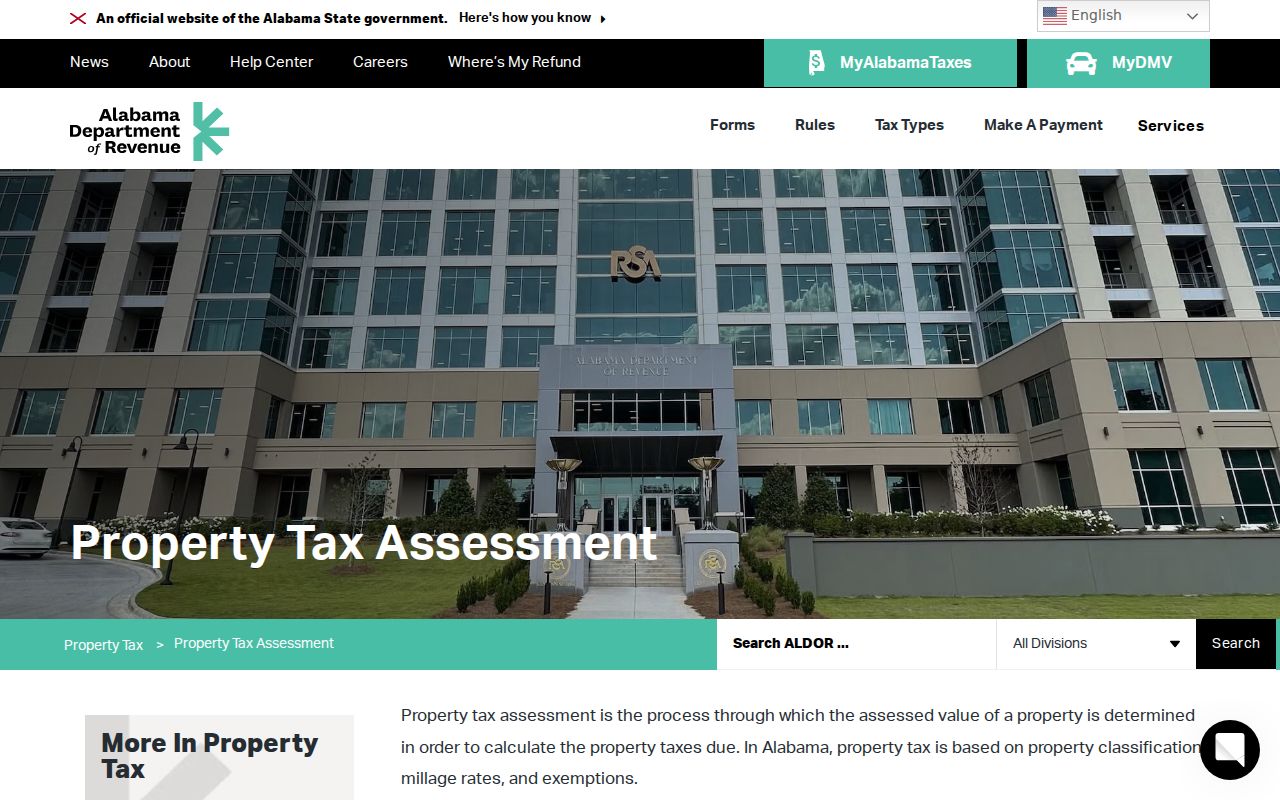
Recorded consideration on a deed is yet another number. It reflects the document's transaction information and is not the current appraised value or a new independent appraisal.
Alabama Tax Records Follow a Calendar
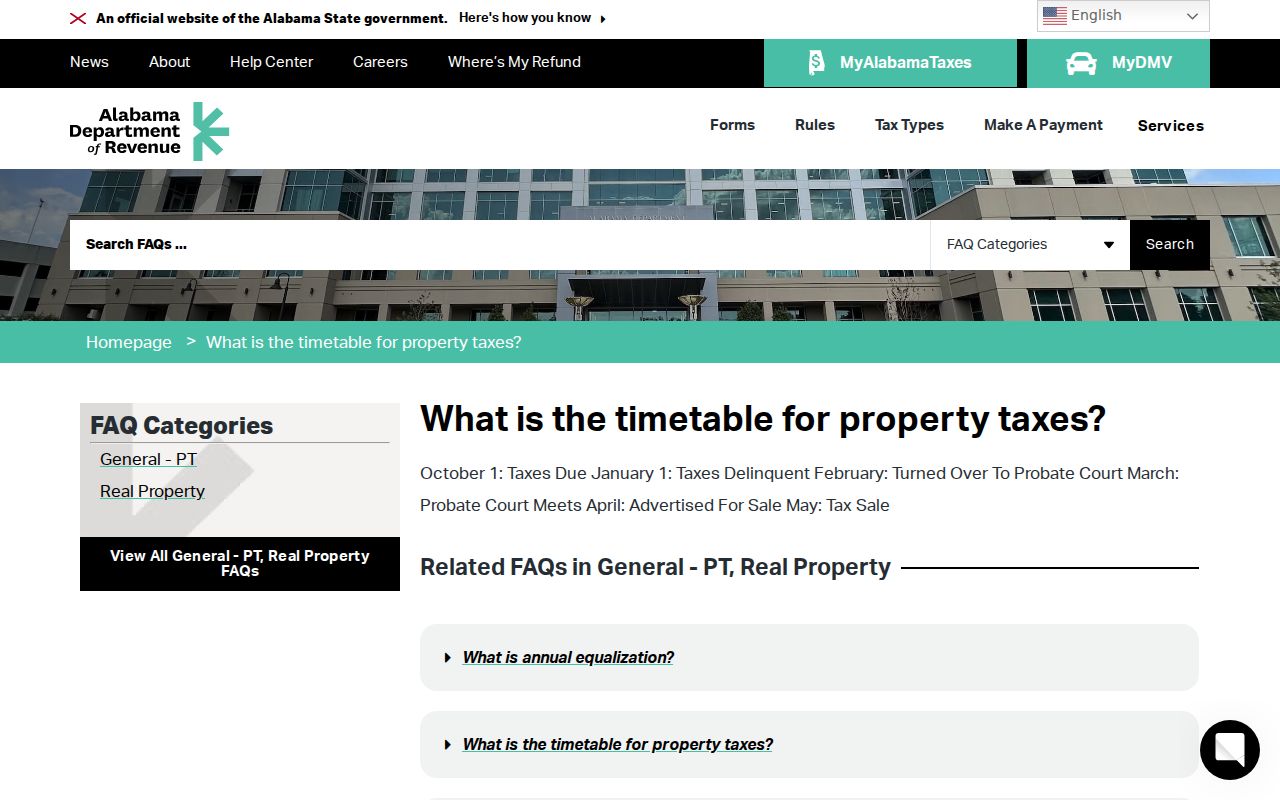
Alabama's annual property-tax calendar gives useful context for any search result. Taxes are due October 1 and turn delinquent after December 31. Delinquent accounts move to probate in February. They are advertised in April. Many then go to a tax sale in May. Exact account, notice, and payment screens are county-run. ALDOR publishes the statewide sequence and links to state-held delinquent-property information.
The ALDOR tax timetable lays out that sequence. The agency's tax-delinquent property page posts county transcript PDFs updated weekly. A transcript may list a name and assessed value. It may also include bid amount, county and year, parcel ID, classification code, and legal description. It may omit a street address. So the county GIS or assessor can help tie a legal description to a map.
A tax-sale certificate or deed is not automatic proof of clear title. Redemption rights and prior recorded interests can matter. Read the county and state records together before relying on a sale entry.
Alabama Parcel Maps Need Local Context
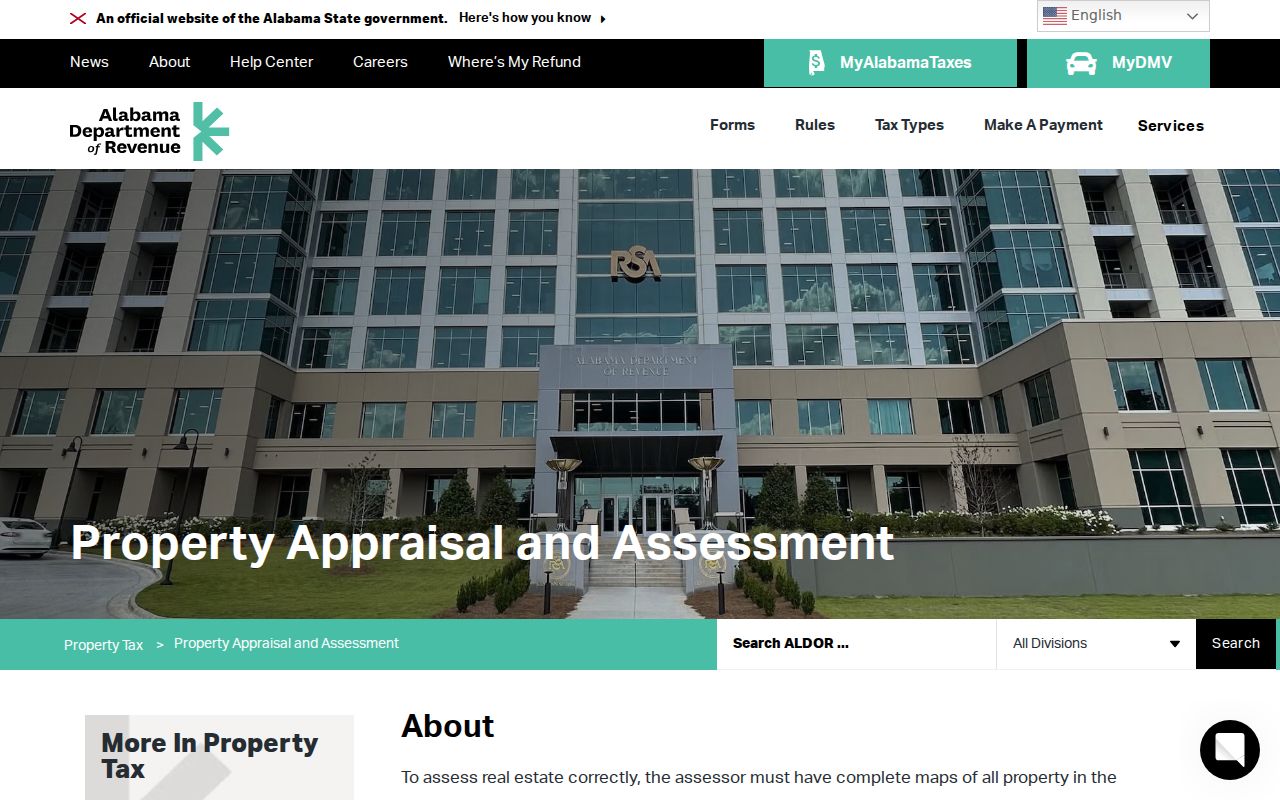
ALDOR's tax-map standards call for maps that display parcel identifiers, ownership boundaries, dimensions, survey lines, and easements. These maps serve as an assessment and inventory aid. Each county maintains its own parcel map layer. Alabama's Uniform Parcel Numbering System supplies a statewide framework. Yet how the number appears, and which parts it shows, differs by county. Treat the APN as a join key. It links the local assessment card, GIS map, tax account, and sometimes the land index.
The Alabama GIS client-site hub routes users to county viewers. It labels each as free public, subscription, or restricted. A public map may allow a search by address or parcel. It may also allow a click on a polygon, a parcel popup inspection, and imagery or district layers you can switch on. Other counties expose fewer tools. No adjacent-parcel or buffer feature is documented statewide, so readers may need to click each surrounding parcel and search its APN separately.
ALDOR's parcel-map standards explain the statewide map framework. The standards give context for parcel numbering without making the Alabama display format uniform.
A GIS tax line is not a legal survey. For a boundary, easement, or access dispute, read the recorded deed and plat, and obtain a survey when exact ground location matters.
Older Alabama Deeds Need a Second Route
Alabama's statehood-era land records live in one place, at least through 1950. The Secretary of State's Lands search reaches them by name, by township-range-section, or by book. After 1950, recording moved to county probate offices. Those offices now hold the modern local title record. So an old deed search can cross two systems. That holds true even when the parcel never left its home county.
For older books, ADAH's County Records on Microfilm catalog takes a county plus one record type at a time. It shows whether a deed, will, estate, or marriage series was filmed. It also gives the date span for each series. Most originals still sit in the local office, ADAH cautions. The archive's county microfilm database also flags courthouse fires. A fire may explain a missing deed book. Yet it does not mean every land record for that county vanished.
Planning an archival request? Include the county, name variants, and approximate years. Add the legal description plus any known book and page or record group. ADAH's research service posts a resident or out-of-state fee. It covers up to 20 pages and limits a request to one surname. Typical answers come in two to three weeks. Even so, the catalog trail often ends at a courthouse visit. That visit yields the original or a cleaner copy.
Index versus image. An online index supplies names and document references; the image is the instrument text and may have a separate fee or login.
Image versus original. A scanned copy may not be available for every year. Older paper books or microfilm can remain at the probate office or archive, so request the volume or film when an online image is missing.
Alabama Open Records Requests Have Steps
Alabama's Open Records Law, Ala. Code §§36-12-40 through 36-12-46, gives citizens a general right to inspect and copy public writings. Statutory exceptions apply. Act 2024-278 built a process on top of it for standard and time-intensive requests. An office may require its own form. It may estimate a reasonable fee. It may collect part or all of that estimate before it searches or produces records.
Standard requests are generally acknowledged within 10 business days. A substantive response follows within 15 business days after acknowledgement. The statute allows written extensions. Time-intensive requests run through their own acknowledgement, estimate, and response steps. None of these timelines promises that every record is public. A request can still need clarification before it is filled.
Keep the request tight. Name the county office, the parcel or APN, the record type, and the date span. Include any instrument number or book and page, plus your preferred format. When the online index runs thin, a county clerk or probate office may offer a counter terminal, a paper or mail copy procedure, or a local form. Read the Alabama Open Records Law. Read the custodian's own instructions on timing and fees.
Alabama Property Alerts Watch Filings
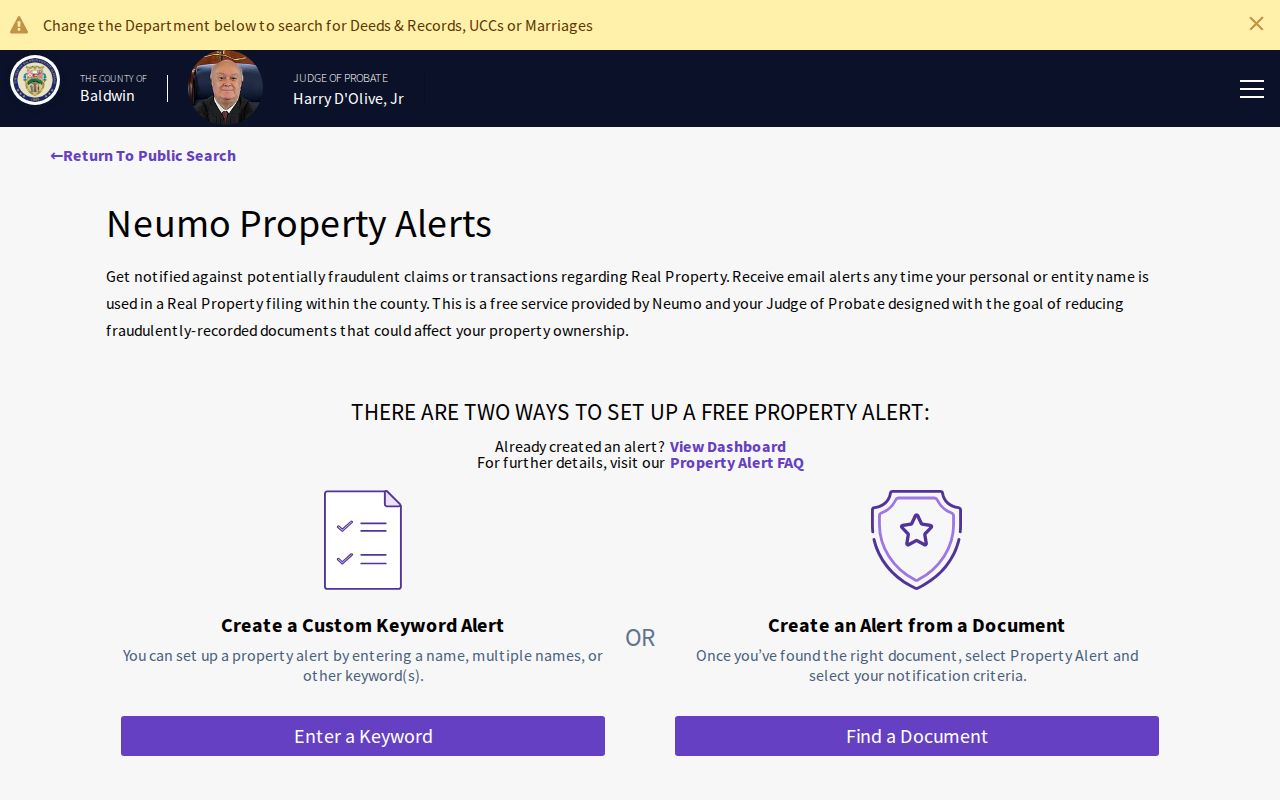
Some counties offer an optional alert service. It fires when a registered name shows up in a land-record filing. Mobile and Baldwin offer two examples. Mobile's program watches for a name recorded in its land system. Baldwin links to a free property-alert service meant to notify an owner about new filings. Treat any notice as a prompt to pull the instrument itself. It will not block a filing or settle whether the deed is valid.
The Baldwin alert page lays out the county's sign-up path. The page reflects a county-specific service rather than a statewide Alabama registry.
Watch for filings you did not expect. A deed or mortgage you never signed can appear in the official record. If one does, call the county probate recording division. Local law enforcement should hear about it too. Skip any unsolicited mailer offering deed copies for a fee. Use the county's own copy process instead. Alabama has a new tool coming: the Alabama Property Protection Act of 2026. It takes effect October 1, 2026. The Alabama Securities Commission says it is drafting the process, rules, and forms, so follow the Commission's current guidance for updates.
What Alabama Property Records Can Prove
Alabama property records prove what a custodian actually recorded or placed on a tax roll. They can show a named owner of record. They can show a parcel's assessed characteristics, a recorded conveyance, or a lien and its release. They can also show a tax bill or a map reference. What they cannot do is equal proof of residence, completeness, or exact boundary lines. A record does not confirm the listed person lives at the parcel. It does not show that every interest has been found. Nor does it make a mapped line exact on the ground. Even a fresh instrument may need review against older deeds, plats, and court orders.
Lawful use. Use public land records for property research, purchase or boundary diligence, tax questions, and civic transparency. A search is not a title opinion, appraisal, or survey, and Alabama law does not permit using records to stalk, threaten, or harass another person.
Alabama Records Systems Keep Changing
County systems do not stand still. Vendors, search fields, image cutoffs, and access routes all shift over time. ADAH's 2025 assessment of probate offices named storage, preservation, and environmental controls. It also cited staff training and digitization as ongoing statewide needs. The report urges collaboration with ADAH. That step does not put every county's older books online. A county portal change can redraw the search steps. It can also change the years of images available in one stroke.
Skip the old bookmark. Start at the official county directory or probate-office page and confirm the current portal. Upgrades often move historical images. Verify the present search and copy process with the custodian. The ADAH probate-office assessment details those preservation priorities. It also backs checking access options with the county custodian first.